Monday, February 29, 2016

Tumble-Dryer

Our tumble-dryer was one of the product-recall ones, due to a 'filter fire-risk'. A recent email from Hotpoint:
"Your repair status

"Due to high demand it is currently estimated that we will be able to complete the modifications to your tumble dryer in November.

"We will be in contact with you in due course to arrange the repair visit from our engineer.

"You need take no further action if this is your preferred option.

"Alternatively

"If your dryer is over 1 year old and you would prefer not to wait until November for your repair; as a goodwill gesture, we are able to offer a brand new Hotpoint tumble dryer at a reduced price. For the reduced price, we will deliver, install, remove your existing appliance and replace it with a new dryer.
November! They've got us over a barrel here - but with a five year old device (which has given us no trouble) we naturally arranged for the upgrade at £99.

The dangerous one

The T/D gap

The new one

Registering the device on the phone, I got the stick and carrot from the call centre.

One year warranty and parts free after that for a further nine years. But the parts can only be fitted by a Hotpoint engineer and there's a fixed call-out fee of £199.99 (the full cost of our new tumble-dryer is £299).

Or, ... , you could just pay £2.30 per month (for ever) and we'll fix/replace it for ever.

The seduction of lock-in - I love marketing.

Ignoring the time cost of money, it would take
£299/£27.60 = 11 years
for Hotpoint to break even, so I guess this tumble-dryer is designed to work for quite a while.


We rejected the deal: if it breaks out of warranty,  we'll just buy a different one.

Saturday, February 27, 2016

You're similar to your spouse in so many ways ...

You already knew that spouses were correlated for intelligence.


R Plomin and I J Deary have this to say:
" ... Assortative mating is greater for intelligence (spouse correlations ~0.40) than for other behavioural traits such as personality and psychopathology (~0.10) or physical traits such as height and weight (~0.20)."

Here's what a correlation of 0.4 looks like (top right).


Marginal Revolution gets excited about this result though:
"Nordsletten and colleagues find an amazing amount of assortative mating within psychiatric disorders.

"Spouse tetrachoric correlations are greater than 0.40 for attention-deficit/hyperactivity disorder (ADHD), autism spectrum disorder (ASD), and schizophrenia.

"The next highest spouse correlation emerged for substance abuse (range, 0.36-0.39).

"Assortative mating was significant but far less substantial for other disorders, such as affective disorders (range, 0.14-0.19)."
They conclude:
"Beyond genetics and genomics, assortative mating matters because it means that the person closest to an individual with a psychiatric disorder is also likely to have psychiatric problems, which could exacerbate problems for both spouses and their offspring."
The ubiquity of assortative mating - who knew?

Thursday, February 25, 2016

Spatial Awareness


There's a special feeling of relaxed contentment when you're back home from the dentist.

Shards of memory: lying back, staring at fluorescent grills in the ceiling, everything yellow through the goggles; the steel hypodermic syringe, floating above my face, orienting there .. and there; the pressure of fluid building up in the gums.

The pretty, full-faced assistant asks the dentist, "Is there anything you need?"

Sotto voce I hear his reply: "Spatial awareness ... ."

I manage a contorted smile.

Later it seemed to me that he was a dead ringer, sight and sound, for Moriarty in BBC's "Sherlock".

---


I'm reading "Data and Goliath: The Hidden Battles to Collect Your Data and Control Your World" by Bruce Schneier.  It's an easy read and brimful of fascinating information about government and corporate surveillance.

I've been trying to identify the chronic, low-level irritation I'm experiencing as I turn the Kindle pages. And now it's dawned on me:  that moralising tone. It's the same feeling I get when reading The Guardian.

Wednesday, February 24, 2016

Combat the four whites!


The four whites are bread, pasta, potatoes, rice. These high-GL bad boys have been replaced in our diet by mashed beans (looks like mash, tastes quite a bit different), cauliflower rice (looks nothing like rice, tastes nothing like rice) and sweet potato (pretty much like potato - but a deafening chorus assures me it's OK).

 I think my favourite new diet element may be the Sauerkraut.

 ---

Is it ever the same day at every location on Earth?

You need to be thinking about the International Date Line and the Midnight Line, the north-south arc where it's always locally midnight. Interestingly, the former is a coordinate of convention while the latter is coordinate-independent.


Crossing the IDL, you always transition to the day before; crossing the Midnight Line you always transition to the day after. When these two line coincide ... they cancel.

Visualising 3D spatial geometry is difficult, isn't it?

 ---

Oh Lord, Emma Thompson and a chorus of luvvies want us in; George Galloway (Britain's answer to Mussolini) and a bunch of UKIPers want us out. What's a sensible person to do!

When I was young my father was baffled by my strange geekish persona and declared I had 'no common sense'. He sometimes called me 'goon' after a character in his favourite radio programme, 'The Goon Show'.

Neddie Seagoon - 'an affable but gullible idiot'

I have profoundly agreed with his general approach since I discovered that the genius John von Neumann wanted the US to launch a first thermonuclear strike on Russia in the window before the Soviets got the H-bomb.

That's why I'm less than impressed by the intellectual Michael Gove's high-minded and thoroughly rational fretting about 'sovereignty'.

Sunday, February 21, 2016

Our elites were selected for .. what?


Gregory Cochran, Jason Hardy and Henry Harpending's seminal 2006 paper, "Natural History of Ashkenazi Intelligence" (PDF) is a gift which keeps on giving.

It outlines their case that "the unique demography and sociology of Ashkenazim in medieval Europe selected for intelligence. Ashkenazi literacy, economic specialization, and closure to inward gene flow led to a social environment in which there was high fitness pay-off to intelligence, specifically verbal and mathematical intelligence but not spatial ability."

The Ashkenazim were not the only people doing highly g-loaded work during the 800 years from 800-1600 AD; why were similar pressures not pushing up the IQ of Caucasian elites?

On page 14  we see this:
“It is likely that the selective pressures affecting the medieval Ashkenazi were far stronger [...] because such a high percentage had cognitively demanding jobs, and because the Ashkenazi niche was so specifically demanding of accounting and management skills, while upper classes elsewhere experienced a more diverse set of paths to wealth.

“Societies reward different behavioural traits. In some times and places successful warriors and soldiers have had high status, in others merchants, in still others bureaucrats as in ancient China. There were societies in pre-modern Europe in which merchants and businessmen ranked near the top, but this was atypical.

“To the extent that status and wealth were inherited rather than earned, the correlation between cognitive traits and reproductive success in elite groups may have been quite weak. In almost every case elite groups experienced substantial gene flow with other, much larger groups that were not subject to the same selective pressures. This means that the selective pressures experienced by such groups were diluted, spread out into the general population.

“Christian merchants in London or Rotterdam may have experienced selective pressures similar to those of the Ashkenazi Jews, but they intermarried: there was extensive gene flow with the general population, the majority of whom were farmers. The selection pressures experienced by farmers were probably quite different: most likely cognitive skills did not have as high a correlation with income among farmers that they did among individuals whose occupations required extensive symbol manipulation, such as moneylenders, tax farmers, and estate managers.”
What was almost certainly selected for amongst the elites was prosociality (usually conceptualised as Agreeable+ and Conscientious+). The Empathy Quotient seems to be the nearest we have to an instrument measuring this.

Prosociality allows the elite to cohere, to negotiate disagreements in a reasonably harmonious way and to conduct long-term and elaborate cooperative ventures; essential to running complex economies and disparate empires. It also seems evident that there's a prosociality gradient running down the class structure of complex societies - it would be good to see some statistics.

Prosociality generates a specific self-ideology when its tenets are normatively extrapolated to everyone under all circumstances. In this malign form, it surfaces as political correctness - "I can tolerate anything except intolerance".

Maddening though it is, let's not throw the baby out with the bathwater.

Mr Trump, I might be talking about you.

---

See also my post about elves (!) for more about political correctness and moralising.

Michael Mosley's Paleo-Diet?

Yesterday I had an epiphany: Michael Mosley's M-Plan Diet; the Mediterranean diet; the advice to shop around the edges of the supermarket, not in the middle; the injunction to keep off processed food; .. weren't these all instances of the paleo-diet?

There is nothing wrong with believing that an animal is most at home in its Environment of Evolutionary Adaptation (EEA), pretty much by definition. My argument with the paleo-diet is its simplistic idea of what that environment is for Caucasians. There's plenty of evidence for genetic adaptation over the last ten thousand years to neolithic innovations such as grains, milk and alcohol.

The real bad thing in contemporary food is over-processing, specifically sugar-boosting, and that dense, so moreish sugar-fat combination which packs on the calories at the expense of fibre. You know who you are, breakfast cereals and cookies. Bread has been compromised, not because of wheat, but through added sugar and denuded fibre.

By cutting these bad boys out, all the diets in the first paragraph put you back in the EEA for contemporary white Europeans. I looked at some paleo-diet websites and saw a lot of good sense .. along with faddy nickel-and-diming over whether bananas were authentically paleo or not.

Conclusion: I guess I'm happy to be tagged as paleo without sweating the small stuff and without having to attend prayers.

Saturday, February 20, 2016

The Welfare Trait: How State Benefits Affect Personality - Dr Adam Perkins

Amazon Link

Perhaps you are fortunate enough to know people who are agreeable and conscientious - the elements of the prosocial personality. Managers love such people: they do what they say they will do, and are a pleasure to deal with.

It will come as little surprise that people with the opposite traits, those who are impulsive and aggressive, are harder to employ. They disproportionately fill the ranks of those on welfare, where - as problem families - they make major contributions to violence and criminality. They also fecklessly create large numbers of offspring and then neglect them.

These stereotypical descriptions are not, of course, constructed from thin air. They summarise countless reports and the daily experiences of people unfortunate enough to have to deal with them.

Adam Perkins, in his book 'The Welfare Trait', calls these people 'employment resistant'. As personality traits are moderately heritable (he quotes 0.3-0.4, Wikipedia has 0.4 -0.6), he suggests that we're rather stupid in our welfare policies to encourage their enhanced reproduction.

How could anyone with half a brain disagree? When you're in a hole, stop digging. But the key issue is how big a problem it really is. The author has some numbers (p. 134 ff) buried in a rather lengthy and turgid discussion, but my impression is that in the great scheme of things it's not the biggest problem we face right now. In any event, his proposed solution of disincentivising reproduction by the employment-resistant would make a difference over generations only at the margins.

Dr Perkins takes 185 pages to make the points above, and his writing is pedestrian and leaden.  His heart is in the right place, and it is of course deplorable that  he has been prevented from speaking by right-on students, but I still couldn't really recommend you buy this book; way too repetitive, not enough sparkle, originality or wit.

---

A review from The Adam Smith Institute and one from Dr James Thompson.

And then there's Rod Liddle in the Sunday Times.
"Sorry, Grand Theft Auto, Dr Perkins is off the bill

"The latest victim of politically correct censorship is Dr Adam Perkins, of King’s College London, who believes that unemployed people are unspeakably ghastly.

"This is a somewhat crude distillation of his work, The Welfare Trait, in which he suggests that a large tranche of long-term welfare claimants are employment-averse, belligerent, unconscientious and disagreeable, traits they painstakingly propagate in their awful children, who have names like 50 Cent and Grand Theft Auto.

"Perkins was “saddened” to find his lecture at the London School of Economics cancelled after adverse social media comment about his eminently sensible thesis. One hysterical campaigning organisation, Black Triangle, suggested his views would meet with the approval of Iain Duncan Smith. That’s apparently enough to get you banned from speaking."
Rod, you are so bad.

---

A final remark: prosociality is often assumed to be wholly positive, but there's a reason we're not all doves. The best soldiers are often the worst citizens.

Friday, February 19, 2016

The Boys in the Bubble

Bagehot in "The Economist" today

Bagehot writes:
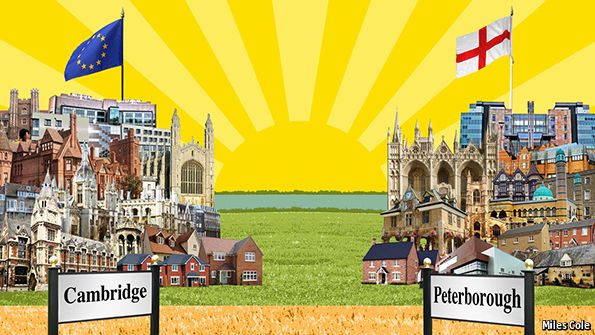
"BEING a Eurosceptic in a university city is a lonely business. In the drizzle outside the Cambridge Union a student in a roll-neck is trying to hand anti-EU leaflets to the cliques hurrying past. Most ignore him. One, having taken a folded piece of card, glances at it and sighs “nah”, shoving it back into the campaigner’s hand.

"Inside, in the neo-Gothic chamber, pro-EU luminaries ply their arguments to cheers. When Richard Tice, an anti-EU campaigner, delivers his speech students bob up and down, machine-gunning him rebarbative questions. Did regulation not exist before Britain joined the union? Why do so many firms support membership? If Britain doesn't control its borders why do foreign students struggle to get visas?

"When Mr Tice quotes “the highly respected economist, Tim Congdon” (a notorious Eurosceptic) the chamber resounds to laughter and sarcastic applause."
Things are different in Peterborough.
"Compare that with Peterborough, a similarly sized city at the other end of Cambridgeshire. At a public debate there locals voted decisively in favour of Brexit. “I asked rhetorically what the audience would put at risk to leave the EU,” recalls Mr Huppert. “They shouted back: ‘Everything’.”
Cambridge and Peterborough are geographically close and in many ways quite similar, so why the different attitudes to the EU?
"Cambridge bears the hallmarks of an economy in which one in two has gone to university, Peterborough is visibly a city of school-leavers.

"When it comes to the EU, this difference is everything. Education levels are “an extremely strong predictor” of an individual’s views on the subject, stresses Robert Ford, an expert on public opinion: the more qualifications someone has, the more pro-European he or she is likely to be.

"According to polls by YouGov, those educated only to 16 oppose EU membership by 57% to 43%, but among graduates it is 38% to 62%. When education is controlled for, other factors affecting an individual’s views on Europe—like income, choice of newspaper and even age—diminish.

What is it about those five years of study between 16 and 21? The answer has two parts. First, the self-interested one. “Having a degree is increasingly a prerequisite of getting on in life,” observes Mr Ford, adding: “Both sides are aware that there is a drawbridge called university and that those who don’t get across it are disadvantaged.”

[...]

"The second, cultural driver mostly concerns immigration. Whereas many in Cambridge see incomers as highly educated Germans and Swedes bringing their expertise to research projects, start-ups and product-development meetings, in Peterborough they are Lithuanian potato-pickers who, if not competing with locals for unskilled work, are at least nipping at their heels."
The Economist has sussed out the underlying trend though:
"University attendance has exploded, which suggests that Britain will become more internationalist and comfortable with EU co-operation. Yet in the meantime it seems the country will be increasingly polarised: liberal, Cambridge-like places on the one side; nationalist, Peterborough-like ones on the other and an ever-shrinking middle ground between the two, as the population bifurcates into those whose skills make them globally competitive and those who must compete with robots and the mass workforces of the emerging economies.

[...]

"Eventually Britain will look more like Cambridge than it does today."
In the year after taking A-level (i.e. at age 18+) 52% of young people were at a higher education institution - with one per cent at Oxbridge and another 8% at other Russell Group universities, according to a Government report.*

So Oxbridge is taking the top 1% of the population age-cohort and inducting them into an international elite bubble. I feel it is unlikely, short of the initiative described in my previous post, that very much more of Britain 'will look more like Cambridge in the future than it does today'.

There are better, more forward-thinking arguments which might speak to Oxbridge undergraduate as to the merits of leaving the present incarnation of the Holy Roman Empire. But that's for another day ... although ironically, The Economist got there before me.
___

Update: (March 18th 2016): see also "Brexit: the issue is Germany".

---

* These figures are interesting. If the 1% admitted to Oxford and Cambridge were selected entirely on merit, the IQ cut-off would be z = 2.33 SD, or 135. If you believe that some get into Oxbridge by not being quite as bright as that, but by having connections, then the merit IQ threshold will be greater than 135.

For the Russell Group  (the top 24 non-Oxbridge including my own alma mater, Warwick), you have to be in the top 9%. This requires z > 1.34, or an IQ of at least 120. In practice, IQ demands are likely to be less for non g-loaded subjects like English and Drama (plus there are those connections again), so this is very much a lower bound for disciplines positively requiring high-IQ (typically STEM subjects and philosophy).

---

We were in the Cribbs Causeway Mall today, pictured below, where I replaced my Primark trousers with softer and more luxurious variants from John Lewis at seven times the price.

The author at Cribbs Causeway Mall

I also popped into my first Apple store. I was expecting style and imagination, but was confronted by six large Formica-like tables upon which were arrayed rows of tethered iPhone 6s and MacBook Air laptops. The whole experience seemed tacky and impoverished; the shop was, however, crowded.

Thursday, February 18, 2016

Boosting IQ by 15 points (truncation selection)

It's 2025 and England, having left the EU, has to fend for itself in competitive battle against China. It's not easy: the Chinese are very smart and out-innovate us in key sectors - financial services and high technology.

Something has to be done.

A secret Government task force reports. The problem is our human capital: we're just not smart enough; we can't hack the highly abstract, interconnected and complex realities of the new economy. We have to give our population an IQ boost.

Farmers have known for centuries what to do; animal breeding and genetics professionals have worked out all the details. You identify the traits you want and select that proportion of the population which - if bred together - will deliver offspring with the desired characteristics.

Evolution in action.

'What do we need?' asks the Minister.

Nothing less than a boost in our average population IQ of 15 points, the report suggests, which would bring us up to the level of the the Ashkenazim or India's Brahmin - and better than the Chinese average IQ of 106.

'OK,' says the Minister, 'and how would we get there?'

The report has done the calculations. We'd have to restrict breeding to those people with an IQ greater than 109. Basically, middle-class professionals and up.

The Minister ponders: 'We're doomed.'

---

The report had an easy-to-read annex which is reproduced below.

State-enforced eugenics has had a deservedly poor press. But voluntary, on-demand child improvement - without coercion - is an easier sell. Putting breeding restrictions to one side, the report also talked about making gene-editing and embryo-selection options widely available, perhaps free on the NHS for the poor.

Perhaps England can hack the 21st century after all.

---

Truncation selection

As a running example, we take a population of potential parents with mean IQ 100 and standard deviation 15 IQ points; this is broadly the Caucasian English population. We wish to identify a proportion of high-IQ individuals (p%) to breed from, so that their offspring will have an average IQ one standard deviation, σ = 15 IQ points, greater than the current overall parent population.

The related questions of interest:
  1. What is the IQ cut-off threshold, above which we permit high-IQ parents to breed?
  2. What proportion of the overall population parents do we allow to breed?
  3. What is the average IQ of the selected parent-breeders?
We know that the parent-breeder IQ has to be higher than the target IQ in the offspring, because of regression to the mean. This reflects that some of the parents' higher intelligence is due to "luck" - what we euphemistically call 'environmental influences'. In the offspring, this luck goes away and only that portion of intelligence due to (additive) genetics contributes. This is captured by the heritability being less than one.


S is the mean of the selected population minus the population mean, (example: 118.75 - 100 = 18.75, as we shall see).

h2 is the heritability of the trait (example: for IQ we'll assume h2 = 0.8 - estimates vary)

R is the mean of the offspring of those selected minus the population mean, (example: 115 - 100 = 15).

We can now define the relationship between the mean incremental-IQ in the selected parent-breeders and the mean incremental-IQ of their offspring. It's the breeder's equation.
R = h2S.
Knowing R and h2 we can easily work out S. For our running example, we want a future breeding population with mean IQ of 115 (ie R is 15) and the heritability, h2, is 0.8.
So S = 15/0.8 = 18.75.
The mean IQ of our selected parents has to be 118.75.

Connecting proportion allowed to breed (p) with their mean trait-value (S)

This doesn't tell us what proportion of the population is going to be allowed to breed. We need another equation relating S and p, the proportion of the population (on the right-hand side of the bell curve) allowed to breed.

Note that p is the area under the curve on the right of the distribution (see picture above), and S is the mean value of that selected area (in units of σ).

This equation is:
S = σi(p)
where σ is the population standard deviation (15 IQ points) and i(p) is a function we look up in tables, called the 'intensity of selection'. Once we know i(p), we can work backwards in the table to look-up p.

Let's do it.
i(p) = S/σ = 18.75/15 = 1.25. *
Looking up in the tables, p = 26%.

Looking at the selection intensity table below, if we select 26% of parents from the top of the existing intelligence distribution and allow them to breed, the average IQ if their children will be 115, one standard deviation greater than at present.

Note that the average IQ of these parents will be, as we already saw, 118.75.

The IQ cut-off (below which we don't allow anyone to breed) is the truncation point x0. From the table below, it's 0.643 (standard deviations) which equates to an IQ of approximately 110.

The result of all this hard work? Our selected offspring will have an average IQ of 115 - that puts them on a par with the Ashkenazim or Brahmin, and better than the Chinese average of 106.

Job done in one generation!

---

* We can combine the two equations to eliminate S, so that
R = h2σi(p), or

i(p) = R/(h2σ)   -   (example: i(p) = 15/(0.8 * 15) = 1.25 as above).
---

Here is the table for i(p).


Further Reading
  1. A slide overview (PDF).
  2. A useful handbook, 'Selection and Genetic Change' (PDF), by Erling Strandberg and Birgitta Malmfors . 
  3. The appendices to the above (PDF) with the maths for the intensity of selection function.

Pamper your gut biome

Since "cutting out the white stuff" I have lost two pounds in just over two days without feeling in the slightest bit hungry; Clare has had similar results. Truly the stuff of tabloid headlines.

In today's Times, Jenni Russell writes:
"Evidence is growing that the destruction of our gut bacteria by processed food is the real enemy.

[...]

"There are dozens of human and animal studies demonstrating how contemporary diets rich in processed food, transfats, artificial sweeteners, additives, corn, soya and wheat devastate the huge variety of good bacteria that live in our guts, and replace them with strains that create inflammation and weight gain.

"That switch in our eating habits took off in the 1980s, when we ditched butter, full-fat milk, eggs, red meat and three meals a day in favour of frequent snacks, sugary drinks, ready-made meals and low-fat, high-carbohydrate food. Instead of an internal garden we created an arid landscape filled with weeds."
Somehow, it's always the mice which get the short straw.
"In a fascinating 2013 experiment by the genetic epidemiologist Tim Spector, from King’s College London, researchers took intestinal microbes from pairs of twins where one sister was obese and one lean, and transferred them into mice. All mice were fed the same food. Yet the mice given the “obese” bacteria grew fat. The mice with the lean sister’s bacteria stayed lean. Then, just to prove the point, the scientists gave the fat mice bacterial transplants from the lean ones — and the fat mice lost their excess weight.

"The clear implication of the research is that if we continue to eat a classic western diet then even if we reduce our calories we’ll fight to lose weight or keep it off. Our bacteria will act like a fifth column, simultaneously fattening us and sending us subversive chemical messages demanding more sugar or fat. The exciting element of the theory is that just as our microbiome was ravaged by dietary changes, so it’s probably in our power to rebuild it — and the changes can start in days."
All roads lead to Dr Michael Mosley ...
"Dr Spector and other leading figures in this field say the solution is simple; replace processed food with the natural foods we used to eat, particularly spices, herbs, fermented foods and fibre-rich plants. Variety is the key to internal regeneration. We used to eat around 150 different foods; now many of us eat only 20, packaged in 50 ways.

"And if broccoli for breakfast, nuts and sauerkraut for lunch and green smoothies for snacks is too much to bear, there’s always the cheat’s option. Sidle up to the skinniest person you know and find out what it might take for them to give away their good bacteria."
No thanks, I think I'll stick to natural yoghourt, sauerkraut and Camembert for my good bacteria.