Saturday, September 03, 2016

The Experience Room

Look at pictures of your parent's house as compared to yours. It's a bit cluttered but in essence not a lot different, is it?

Not as many electrical points.

It's tempting to assume that, like the bicycle, we've got there. We know how to make the ideal person-cave.

Not at all. We're in the interregnum while they figure out programmable matter: self-reconfiguring smart dust, computronium.

You know, like how the Terminator gets smashed up, then flows like a black fluid back into .. the Terminator.


The house of the future. It's made of smart matter - tiny programmable components which attach to each other to form chairs, tables, rugs, pictures and screens. We sometimes call computers a case-study of 'deferred design'; the future dwelling is deferred décor.

Your apartment will simulate any reality by creating smart-dust avatars (telepario) with the floor, walls and ceiling showing synthesised scenes. VR without the helmets.

You might still run into the walls, though. Much better to directly stimulate the brain. Emulate all sensory inputs and interpret all effector outputs in a totally simulated environment.

How many SF stories have we read with that theme? The slippery slope to the prospect of the brain in a vat, so unsettling at the end of Dan Simmons's spooky 'Flashback'.

We're living the transitional decades, waiting for AI, nanotech, genomics, neuroscience and materials-tech to catch up. The world will then lurch to a very different place.

Friday, September 02, 2016

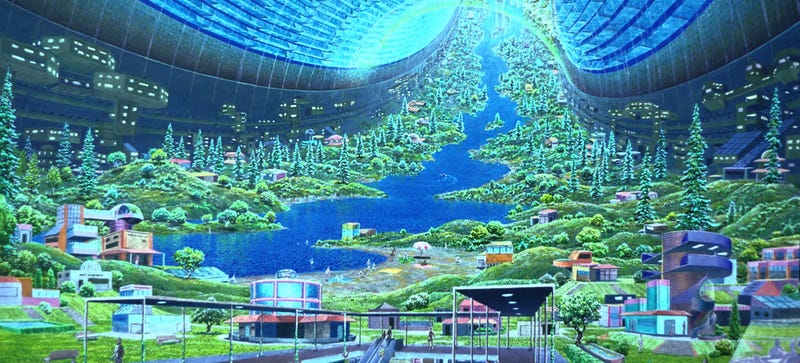
And is it utopia we seek?


'Utopia',  a word coined in Greek by Sir Thomas More for his 1516 book Utopia, describing a fictional island society in the Atlantic Ocean. The word comes from the Greek: οὐ ("not") and τόπος ("place") and means "no-place".

Plenty of people seem to have had a recipe for the kind of place it should be. Writing in The Times today, Philip Collins, a senior adornment to the Labour Party, deploys his customary literary erudition.
"Imagine a nation where all 54 cities were identical and all private houses were exactly alike. Citizens change house every decade to ward off feelings of possession. Adults have no choice over their workplace; all are conscripted into the fields and children are raised in orphanages.

"All are considered equal and nobody is poor but everyone must wear the common habit, and cloaks are of one colour. This picture of the perfect society, from Thomas More’s Utopia, is 500 years old."
Collins sees a disturbing link between utopian political projects and rather dystopian outcomes.
"The recurring nonsense in utopian thought is that perfection comes too easily. Sometimes a traveller discovers the ideal commonwealth in the new world, as in Francis Bacon’s New Atlantis. Sometimes, like Edward Bellamy’s Looking Backward, the hero simply dreams the ideal world into being. The title of one of HG Wells’s dreary utopias summarises the trick: When The Sleeper Wakes.

"The other utopian technique is to hand the creative task over to a preternaturally brilliant elite. For Plato it was the philosopher-king and for Saint-Simon a standing army of industrialists. In later utopias, scientists take the role once occupied by priests; in BF Skinner’s Walden Two, the psychologists are in command, conditioning perfect people. The elite puts people into neat tailored uniforms. It’s a short step from there to having Big Brother watching you.

"William Morris, in News From Nowhere, captures the attitude of all utopian writers: “we have no need of politics”. In a land where all desires have been satisfied there is no poverty and no conflict. People are willing to give up personal liberty because the enlightened despots in charge understand what they really want."
Where is Collins going with this? A modest bait-and-switch. He wants to extract a standard, rather subsidiary objective of all utopias, the ending of poverty, and rescue that as a laudable political project.
"That dismissal of scarcity might seem the archetypal utopian fantasy. In fact, it is not. It is exactly the kind of practical, achievable aim that democratic politics in a rich country should be setting itself.

"On Tuesday, after four years of study, the Joseph Rowntree Foundation will launch a campaign to eradicate poverty in the UK. The JRF’s specific aims are to ensure that nobody is ever destitute, that fewer than one in ten Britons are poor at any time and that nobody remains poor for longer than two years. The redeeming feature of utopian thought was always the critique it offered of the status quo and the JRF is utopian only in that sense.

"This is a prosperous country and the existence of poverty on its present scale is shaming. A child born into a poor family will have a lower birth weight than a child born to a rich family. By the age of three, the cognitive development of a child born into a poor family is already well behind its richer peers. The gap opens during school and is confirmed in work.

"Life for so many people is constant anxiety. There are 2.3 million households, in which 1.5 million children live, that cannot afford to heat their homes. The duration of life itself has a price. The child from a poor family is likely to enjoy nine years less of life than his or her richer counterpart."
Parenthetically we see here the standard denial on the left of genetics, the reassuring but false conviction that everything is environmental so with Government social engineering, all outcomes can be made identical, blah blah blah.

Still, many phenotypical traits are environmental to some extent and certainly do need fixing. This would be some combination of increasing the productive forces (aka 'growth') and some optimised welfare redistribution. Just don't expect equality of outcome - Usain Bolt still gets to win.

---

Let's raise our eyes a little. The best people are in politics because nothing short of utopia will do as a strategic objective. They understand that utopia is not a place, nor a well-defined social regime. It is the maturing society's ability to remove the social shackles and limits on individual lives, letting everyone flourish in their own unique way.

It's been said before:
"From each according to his ability, to each according to his need."
---

Now, I could finish on this modestly optimistic note, but that would be to beg some questions.

  • How do we determine what needs are reasonable?
  • How do we deal with negative externalities - conflicting needs?
  • What about really bad people?

Did the great left-wing visionaries really expect there would be no funding committees and policemen in utopia? Are enlightened 'despots' policing modern social norms so distressing?

If we agree to stop the modern denial of human nature, then we have to take human nature into account. Is utopia a kind of hunter-gatherer paradise where free luxurious cuisine replaces roots and berries, and hi-tech VR systems substitute for mammoth-hunting expeditions?

Is this our destination?

I only ask.

---

Not to leave you with a dangling question, my answer is yes and no. Those on welfare today who lounge around rather than self-improve (yes, they do exist) won't be going away. We collectively get richer - and their 'free' entertainments get more exotic and compelling. If it works for them ...

All those people who want to push the narrative forwards, in arts and sciences and technology and self-improvement and exploring the universe. Well, those challenges aren't going anywhere either.

Short of dramatic genetic self-modification (physically/mentally) at which point all bets seem to be off, this seems a plausible future, building on trends we see today. The question remains: do we get there within the capitalist mode of production or does that have to get superseded en route?

Heteconomist has a thoughtful piece on this very topic.

I'll be writing about it in a post to come, provisionally titled, "Marxist Economics of Total Automation".

Thursday, September 01, 2016

So this was my day today

I do find dentist appointments unsettling, even when it's something as routine as a couple of filling-repairs.

To neutralise my anticipation (the appointment was 11.40 am this morning) I first ran through the exercise sequence which came with my 'York Fitness Cast Iron Dumbbell Set - 20kg'.

Dumbbell exercises

Here is your author in action.


Showered, mouthwashed and toothpasted, I was lying back on the dentist's couch by a quarter to twelve. There is a tone of voice in which the dentist asks,
"Do you usually have an injection?"
where he means,
'Are you some kind of wimp?'
I nodded coolly and said,
"For the replacement of old fillings? Nope, let's give it a go without."
The dentist looked pleased (three minutes shaved off the time) and got to work.

I wasn't really expecting Marathon Man and to be honest it was a breeze; I closed my eyes and thought about Marx's theory of crises.

---

This afternoon Clare's new tablet arrived. The iPad 2 she acquired from my late mother is increasingly clunky and slow, so I decided to replace it with a Nexus 10, a copy of my own but with better battery life.

I ordered mine back in March 2014 and it's worked well. The Nexus 10 is obsolete really, so I was able to get a bargain: Google Nexus 10 Wi-Fi only, 16 GB (Certified Refurbished).

I don't really get 'refurbished'. I assume it's just surplus stock which has been sitting in a warehouse somewhere for a year or so and is now being disposed of. In any event, it arrived in true minimalist fashion: just the tablet and a travelling charger + cable.

Its Android release was early 4 (we're currently at 5.1.1 Lollipop) so I've spent the afternoon loading version after version of the OS as it makes the long climb towards Lollipop. Towards the end I was dismayed to find the tablet kept turning itself off; buy cheap and have to send it back, I thought to myself. But it was simply the Nexus's way of telling me that its battery was down to 4%.

It's currently on the charger, telling me it's still too tired to install the latest Android iteration.

I have to wait.

Why Marxism refuses to die

Link to PDF

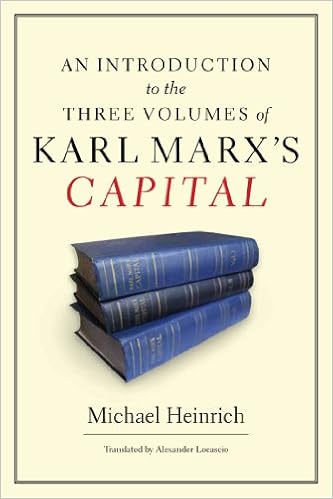
Michael Heinrich starts his book (above) with reasons we should still be interested in studying Marxism.
"“At the beginning of the 1990s, after the collapse of the Soviet Union, it seemed as though capitalism had ultimately and globally triumphed as an economic and social model to which there was no alternative.

“Although there had always been many on the left who did not see a desirable alternative to capitalism in Soviet “really existing socialism,” such distinctions no longer seemed important. To most people, a society beyond the capitalist market economy appeared only as an entirely unrealistic utopia. Instead of protest, accommodation and resignation reigned.

“But it was also - and in particular - the 1990s that showed that capitalism, even after its apparent “final victory,” continued to go hand in hand with processes of crisis and immiseration; and Kosovo, Afghanistan, and the first war in Iraq showed that wars in which the developed capitalist countries were not only indirectly, but indeed very directly involved, were by no means a thing of the past.

“All this was taken up in different forms by the new “counter-globalization” movement and other social movements and made the point of departure for critique. Initially, these critiques were focused on single issues and posed limited demands that remained within the framework of the system. Furthermore, the critiques often rested upon a simple black-and-white moralism.

“However, throughout the course of these conflicts, fundamental questions kept being asked: about contemporary capitalism’s mode of operation; about the connection between capitalism, the state, and war; and also about what kinds of changes are actually possible within capitalism. Leftist theory became important again.

“Every transformative practice assumes a particular understanding of that which exists. If, for example, we demand the introduction of a Tobin tax (that is, the taxation of currency transactions) as a crucial means for the “taming” of a capitalism “unleashed”, then this implies a certain theorization of the importance of financial markets, about tamed or untamed capitalism - whether or not these assumptions are made explicit.

“How contemporary capitalism functions is not an abstract, academic question.”
---

Let me continue the point with an analogy. The practitioners of feudalism conceptualised their society as three Great Estates: clergy (the First Estate), nobility (the Second Estate), and commoners (the Third Estate). A monarch, ruling by divine right, oversaw everything.

One might have observed in the interstices of society small-scale artisans employing a few people, usurers lending money, and merchants importing scarce luxuries. But these would not seem essential to the overarching 'structure' of society.

A feudal 'sociologist' might well assume the future to be like the past. The future king arbitrates between future groups of nobles; the church acts as power-broker and society's ideologist, while the commoners (peasants and artisans) work for a pittance and pay for it all. It's all sanctioned by God and how could it change - even in principle?

In actual history, the commoners lost their lands and became proletarians while the merchants, usurers and lower gentry transformed themselves into capitalists. Revolutions duly followed.

What was wrong with our feudal sociologist's theories? By being 'structuralist' they assumed the feudal order of things as axiomatic. But there are no structures, only people doing essential things in relation to each other in defined ways.

Marx talks about the forces and relations of production (and exchange).

---

Modern (bourgeois) sociologists similarly pre-suppose the forms of social organisation of capitalism. They're baked into the theories - economics being a case in point.

But if you're interested in whether capitalism is the last word on human social organisation, you can't do that. You have to step back and understand capitalism as just another form of human social behaviour. If people systematically behaved differently, capitalism would vanish like mist in the morning, as did 'communism' in the few short years following 1989.

That wouldn't happen, of course, unless there was a powerful, revolutionary fervour to do things differently: capitalism would have to fail the masses big time, and there would have to be a viable alternative to reorganise to.

For more than a century, Marxists have believed that capitalism contains in its mode of reproduction fatal and terminal contradictions, and that the socialist form of society - consciously planned by the masses - was a far superior, non-commodified mode of production.

But the empirical evidence for both these theses is hard to find. Marx may well have had the right kind of analysis (focus on human social relationships, not mythical 'structures') but was his specific analysis and vision correct?

Georg Lukács famously argued that a Marxist was someone who followed Marx's method, not someone who had to agree with all of Marx's historically-bounded results, hypotheses and suggestions.

I don't know if capitalism is 'the end of history', but I am sure it's a profound question for any human being thinking about how to make the future a better place.

Wednesday, August 31, 2016

Expanded Reproduction in an Abstract Capitalist Society

In the previous post, 'Simple Reproduction in an Abstract Capitalist Society', we looked at a basic model of how a capitalist society engaged in generalised commodity production can reproduce itself - but without growing. If you didn't read that post, now would be a good time - we use it below.

Unlike previous modes of production which were mainly focused on the production of use values, capitalism as practiced by capitalists is motivated purely by the search for surplus value (i.e. growth in capital). The production of specific use values is a matter of indifference as long as the commodities concerned can be sold in the market, thereby releasing their monetary value.

Capitalists will not invest unless they think they can grow their capital, so a properly-functioning capitalist society is a growing one. This has posed a problem for some Marxist economists. How, they argue, can capitalism grow when the workers are paid only a portion (v out of v+s) of the value they produce, and the capitalists - although they live well - need to keep most of their capital gains for further investment?

This has been termed the 'underconsumption theory of capitalist crises' and was the subject of a historical dispute between Nikolai Bukharin and Rosa Luxemburg in the 1920s. Luxemburg thought that capitalism could only grow (via realising the value of an increasing mass of commodities) through vigorous expansion into new markets, and that this explained 'imperialism'.

Bukharin put her right.

So here is Bukharin's model in spreadsheet form - click on image to make larger..

Link to spreadsheet

As before we have Department 1, making machines and raw materials, and Department 2, making consumables to keep workers and capitalists alive for another day's toil.

We split the surplus value created by workers into three categories: that proportion consumed unproductively by the capitalists, (a); that proportion which is capital re-invested in machines, (δc); and that proportion invested in increased labour (δv).

All of the variables here measure capital value, so that δv is increased capital allocated to wages. This could be more workers to use extra machines or raw materials, or more highly-paid (more highly-skilled and productive) workers to use more sophisticated machines.

The constraint between Departments 1 and 2 to ensure that reproduction can occur is a simple generalisation of the previous case:

c2 = v1+a1 and δc2 = δv1.

This equates the constant capital in Department 2 with the payments to workers and capitalists in Department 1 through the endless cycles of capitalist reproduction of the relations of production.

The model is very, very simple. It is assumed that the capitalists don't increase their consumption iteration-on-iteration .. though they probably would. Also, the incremental growth of constant and variable capital is held constant, although it would probably be increasing geometrically. These details don't invalidate the 'in principle' character of the model.

---

  Bukharin comments:
"In other words, the following grow:
  • the constant capital of society, 
  • the consumption of the workers, 
  • the consumption of the capitalists (everything taken in values). 
"In this connexion we will not make any further analysis of the relation in which this growth of the various above-listed values proceeds. This question needs to be treated separately.

"Here we must mention, even if only briefly, the following circumstances: along with the growth of production, the market of this production grows too, the market of means of production expands, and the consumer demand grows also (since, taken in absolute terms, the capitalists' consumption grows as well as that of the workers).

"In other words, here the possibility is given of, on the one hand, an equilibrium between the various parts of the total social production and, on the other, an equilibrium between production and consumption.

"In this process the equilibrium between production and consumption is for its part conditioned by the production equilibrium, i.e. the equilibrium between the various parts of the functioning capital and its various branches.

"In the above analysis we neglect at first a series of highly important, specifically capitalist moments, e.g. money-circulation.
...
"This resulted in a series of the most serious mistakes, it resulted further in the denial of the existence of contradictions within capitalism, finally a direct apology for the capitalist system, an apology which attempts – to use a Marxist word – to ‘reason away' the crises, the over-production, the mass misery and so on.

‘It must never be forgotten, that in capitalist production what matters is not the immediate use value but the exchange value, and in particular, the expansion of the surplus value.'

Here, Bukharin is writing as a typical soviet Bolshevik, echoing Marx's extrapolations of the inevitable fate of capitalism. Reality was to turn out very differently, to the point where it is a genuine and profound question of Marxist analysis as to whether capitalism is indeed subject to structural crises (not just regular business cycles) which could catalyse a revolutionary dynamic towards a higher mode of production.

Tuesday, August 30, 2016

Simple Reproduction in an Abstract Capitalist Society

Link to online PDF

Capitalism is characterised within the Marxist tradition as generalised commodity production; in Marx’s view, a correct understanding of the commodity encapsulates its fundamentals.

Key is the concept of labour power and surplus value. In the following extract from Michael Heinrich’s “An Introduction to the Three Volumes of Karl Marx’s Capital” (Chapter 5, The Capitalist Process of Production), the term ‘means of production’ relates to machinery and raw materials.
“With regard to the value of the newly produced commodities, the means of production and labour-power play completely different roles.

“The value of the means of production consumed in the creation of a commodity constitutes part of the value of the newly produced commodity. If means of production are completely used up in the process of production, then the value of these means of production is completely transferred to the newly produced mass of commodities.

“But if means of production such as tools or machines are not completely used up, then only a part of their value is transferred. If for example a particular machine has a life span of ten years, then one-tenth of its value is transferred to the mass of commodities produced within a year.  The portion of capital laid out in means of production will, under normal conditions, not change value during the production process, but a portion of its value will constitute a portion of the value of the commodities produced.

“Marx calls this portion of capital constant capital, or c for short.

“Things are different with labour-power. The value of labour-power is not all transferred to the commodities produced. The value newly generated by the “consumption” of labour-power, that is, by labour expenditure, is what is transferred to the value of the newly created commodities.
...
“How much value the worker adds to the product of labour does not depend upon the value of labour-power, but upon the extent to which the labour expended counts as value-creating, abstract labour. The difference between the newly added value and the value of labour-power is the surplus value, or s.

“Or to put it differently, the newly added value is equal to the sum of the value of labour-power and surplus value. Marx calls the portion of capital used to pay wages variable capital, or v for short. This portion of capital changes value during the production process; the workers are paid with v, but produce new value in the amount of v + s.

“The value of a mass of commodities produced within a specific period of time (a day or even a year) can therefore be expressed as:

c + v + s

Here c indicates the value of the constant capital consumed, that is, the value of the raw materials and the proportionate share of the value of tools and machines, insofar as they are used.

“The valorisation of capital results solely from its variable component. The level of valorisation can therefore be measured by relating the surplus value to the variable capital: Marx calls the quantity s/v the rate of surplus value. It is simultaneously also the measure of the exploitation of labour-power.

“The rate of surplus value is usually given as a percentage. For example, if s = 40 and v = 40, then one does not speak of a rate of surplus value of 1, but rather of a rate of surplus value of 100 percent. If s = 20 and v = 40, than the rate of surplus value amounts to 50 percent.”
---

An exercises in Marxist economics is to show how capitalism can reproduce itself. In the most basic case, we look at an idealised steady state situation, where capitalists appropriate surplus value and consume it without re-investment.

Expanded reproduction will be modelled in the next post.

The economy is divided into two departments: Department 1 is the sector which creates means of production (machines and/or raw materials); this department provides and reproduces the ‘c’ in commodity value.

Department 2 produces means of consumption:  food, shelter and all the other necessities for the survival and continuing existence of the workers and capitalists. It underpins the ‘v + s’ in commodity value.

For simple reproduction to occur, the following relation must hold*:

c2 = v1 + s1

This says that the value of the constant capital in Department 2 (means of consumption) must be equal to the variable + surplus value in Department 1.

All other levels of capital may be chosen freely to reflect the size of the economy, the amount of constant capital and labour-power employed and the degree of exploitation**. The economy will turn-over and reproduce itself provided the above relationship holds.

Here is an example spreadsheet, followed through 9 iterations. As you can see, it never changes and equivalent values (Exch) are exchanged between Department 1 and Department 2.


Link to spreadsheet

Department 1 has to buy means of consumption for its own workers and capitalists (v1 + s1) from Department 2 (it makes its own constant capital c1); Department 2 has to buy its constant capital c2 from Department 1, but can produce the necessaries of life for its own workers and capitalists (v2 + c2) itself.
Examine the first row of the spreadsheet above. Department 1 (creator of means of production) creates a value of 12 (in some units) in cycle one. This will purchase the next round of machines and raw materials in the second cycle: 3 units of value available for Department 1 and 9 for Department 2 (the creator of means of consumption).

Department 2 creates 22 units of value which supply workers and capitalists: 9 units required for Department 1 and 13 units for Department 2.

The column 'Exch' indicates the values exchanged between Departments 1 and 2. Department 1 'exports' a value of 9 to Department 2 to maintain/'depreciate' its machinery and raw materials; Department 2 'exports' a value of 9 also to keep the workers and capitalists in Department 1 in shape (5 + 4).

In a certain sense, Department 1 'exports' its surplus machine + raw material value while Department 2 'exports' its surplus necessaries of living value. The two have to match in the market place, where they share the common value of 9.

What counts is that the value created in Department 1 over and above what's needed to reproduce its own constant capital (c1 + v1 + s1 - c1 = v1 + s1) is exactly the same as the constant capital recurrently employed in Department 2 (c2). When that is the case, Department 1 finds a market for its output in Department 2 and can therefore afford to buy its necessaries of life from Department 2 (v1 + s1).

Department 2 will employ sufficient workers, at a cost of v2, to properly employ the means of production (of value c2).

The case for expanded reproduction exploits exactly the same procedure.
This proves that capitalist equilibrium (at least in this ever-so-simple model) is possible in principle; in reality capitalists make independent and non-centralised decisions so coordination cannot be as exact as in the spreadsheet. This will eventually lead us into a theory of crises.

Things get a little more complex and interesting when we consider expanded reproduction, the typical case of a capitalist economy in growth.

The subject of the next post: "Expanded Reproduction in an Abstract Capitalist Society".

---

* See 'Imperialism and the Accumulation of Capital, Bukharin 1925' for more details.

--

** 'Exploitation' is a pejorative word but should be here understood analytically. In any form of society which is economically growing, workers will receive less to spend than the value of their work-production. Otherwise, where is the infrastructure of civilisation to come from?

In the case of capitalism, that 'surplus value' is appropriated privately by the capitalist. In feudalism it was appropriated mainly by the aristocracy, and in slave societies it was directly, coercively owned by the slave's master.

In any society where humans work to society's benefit, there will be a social surplus product .. but it may not take the form of surplus value if labour is not commodified.

Who knows whether that will ever come about?
Thursday, August 25, 2016

Proxima Centauri b


I found out about it yesterday, from Paul Gilster's blog, Centauri Dreams.

It had all the right information:


The key question: observe it better with giant space telescopes (maybe a new push for the FOCAL mission using the sun as a gravitational lens) .. or send a probe?

Might a country (the US or China, say?) embark upon a high-prestige, multi-decade-long programme to send such a mission?

It encounters that old starflight paradox: the later launches - so much more technologically advanced - overtake the first ones.

I think it's possible that the youngest children on Earth might live to see close-in imaging of this planet .. and/or a mission that we might have figured out by then how to slow down.

---

Related: this sad little tale from Alastair Reynolds.

"Help Eliza, I'm in trouble!"

I'm something of a subscriber to the view: 'AI's the solution .. so what's the problem?'

The problem under consideration today is that of child abuse, mentioned in this post about Internet paedophiles yesterday, and prominent in continuing revelations about abuse at Ampleforth College.
[Wikipedia: "Ampleforth College is a coeducational independent day and boarding school in the village of Ampleforth, North Yorkshire, England. It opened in 1802 as a boys' school, and is run by the Benedictine monks and lay staff of Ampleforth Abbey.
...
Several monks and three members of the lay teaching staff molested children in their care over several decades. In 2005 Father Piers Grant-Ferris admitted 20 incidents of child abuse. This was not an isolated incident.

"The Yorkshire Post reported in 2005: "Pupils at a leading Roman Catholic school suffered decades of abuse from at least six paedophiles following a decision by former Abbot Basil Hume not to call in police at the beginning of the scandal."]
---

Let me remind you about Eliza, the original chatbot developed by Joseph Weizenbaum.
"ELIZA worked by simple parsing and substitution of key words into canned phrases. Depending upon the initial entries by the user, the illusion of a human writer could be instantly dispelled, or could continue through several interchanges.

"It was sometimes so convincing that there are many anecdotes about people becoming very emotionally caught up in dealing with [ELIZA] for several minutes until the machine's true lack of understanding became apparent.

"Weizenbaum's own secretary reportedly asked him to leave the room so that she and ELIZA could have a real conversation.

"As Weizenbaum later wrote, "I had not realized ... that extremely short exposures to a relatively simple computer program could induce powerful delusional thinking in quite normal people."
Eliza works by matching text input against a large database of templates. Each input template is linked to one or more possible output templates, with variables which can be instantiated to the substantive words from the input.

Eliza might, for example,
"respond to "My head hurts" with "Why do you say your head hurts?" A possible response to "My mother hates me" would be "Who else in your family hates you?"

"ELIZA was implemented using simple pattern matching techniques, but was taken seriously by several of its users, even after Weizenbaum explained to them how it worked. It was one of the first chatterbots."
In addition to crafting a reply, Eliza could easily have updated a user-database with the information it was receiving.

---

It's easy to see how this could be applied to helping victims of child abuse. A key design principle is that the abuser must not become aware that the child is passing on information: this rules out a tailored 'abuse app'.

I suggest a special WhatsApp-connected chatbot with a widely publicised name - let's say Help!.

The child contacts Help! on WhatsApp and the first thing he or she is asked to do is choose a name, say Peter, which is what will appear (instead of Help!) on their WhatsApp contacts list. I think the history of chats with Peter is going to have to vanish too, replaced with harmless confected froth.

The child is typing to an Eliza-like chatbot (maybe more like IBM's Watson than Eliza) which has been trained on scripts from charities like Childline.

Like Weizenbaum, we know that people of all ages are especially likely to confide in an AI agent.

The database which Help! constructs is a transcript of alleged abuse. The real problem is what to do with it. No doubt it's encrypted and identity-protected but at some point someone has to assess whether this is a real or false allegation, and figure out how to proceed.

But these are problems charities already have to deal with.

I think they should move on the app. There's already one for carers.

Wednesday, August 24, 2016

Croquet at the Bishop's Palace, Wells

What a busy day today! I hoovered the house then walked across to the gym for my weight room induction session: bench-press machines and dumbbells; Clare got to mop the floor during this.

Back home Clare cut my hair to something appropriate to iron-pumping and then we strolled to the Bishop's Palace for a late picnic lunch.

Croquet in front of Wells Cathedral

We're fed and watching the croquet intently

I'm told that croquet only looks genteel; in reality it's hyper-confrontational and aggressive.

What would I know? I thought they played it with flamingos.

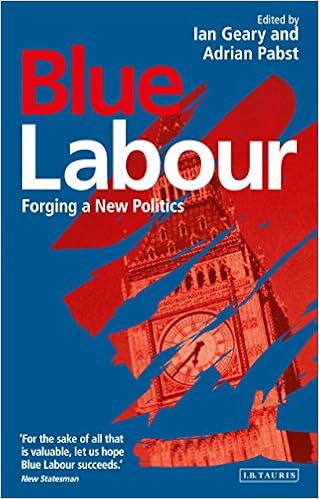
Blue Labour - so disappointing

I was really prepared to like Blue Labour and to that end bought this book.

Amazon link

I read about half the essays before finally choking on the conceptual equivalent of mushy bran.

Here's the story from Wikipedia.
"Labour peer and London Metropolitan University academic Maurice Glasman launched Blue Labour in April 2009 at a meeting in Conway Hall, Bloomsbury. He called for "a new politics of reciprocity, mutuality and solidarity", an alternative to the post 1945 centralising approach of the Labour Party.

"The movement grew through a series of seminars held in University College, Oxford and at London Metropolitan University in the aftermath of Labour's defeat in the 2010 general election.

"Labour figures sometimes associated with the trend have criticised the New Labour administration of Tony Blair for having an uncritical view of the market economy, and that of Gordon Brown for being uncritical of both the market and the state.

"Jon Cruddas, the Labour MP for Dagenham and Rainham and the party's policy review co-ordinator, argued that New Labour's focus on 'the progressive new' resulted in the party embracing "a dystopian, destructive neoliberalism, cut loose from the traditions and history of Labour".

"Chuka Umunna, the Labour Shadow Business Secretary believes Blue Labour "provides the seeds of national renewal".
Chuka Umunna, one of the high priests of metro-liberalism, a Blue Labour guru?

Give me a break.
"Blue Labour suggests that abstract concepts of equality and internationalism have held back the Labour Party from linking with the real concerns of many voters, the concept of equality leading to an 'obsession with the postcode lottery' and internationalism ignoring fears of low paid workers about immigration.

"Blue Labour, alternatively, emphasises the importance of democratic engagement and insists that the Labour Party should seek to reinvigorate its relationships with different communities across the nation, with an approach based on what historian Dominic Sandbrook describes as "family, faith, and flag".
The essays, highly overlapping and uniformly light on conceptual depth and rigour, feature:
  • An ethical/cultural critique of liberal individualism
  • An economic critique of rampant globalism
  • A religious critique of secular atomisation.
So what is to be done?

Way too many essays base themselves on Catholic Social Teaching (various Popes get extensive name checks), a naive idealisation of the increasingly dysfunctional German social and economic model (workers on boards, apprenticeships etc) and the communitarian history of the British labour and cooperative movements over the last couple of hundred years, going back to the Romantic tradition of John Clare (yes, he gets a name check too).

There is no analysis of just why metro-liberal politics, economics and culture have proved so hegemonic over the last few decades everywhere in the western world, and no plausible political programme for going forwards - nothing beyond tinkering at the edges (community organising, anyone?).

No, Blue Labour is a superficial nostalgia-fest built on sand.

Sad.

---

I also bought this which I have yet to read:

Amazon link

I have no hopes.

---

Update (28th August 2016).

I've completed Rowenna Davis's book and it's an easier read than the essay collection above, as well as being way more insightful. It covers the 18 months stretching from the end of Gordon Brown's premiership to the Miliband brothers election and Ed's first year. During this time Blue Labour emerged and then became dominated by Maurice Glasman once he had been elevated (by Ed) to the Lords.

Glasman emerges as an argumentative, self-willed and naive radical activist who fell out with many of his co-thinkers. Interestingly, these were mostly Oxford academics. The other major support groups for Blue Labour were community activists (Citizens UK, led by a patrician bunch of Oxford graduates) and faith groups (Catholics and Muslims predominated).

When the book ends, in 2011, Blue Labour is imploding due to Glasman's egotistical gaffes. Plainly, it recovered later, but in the age of Corbyn its profile today is invisible.

I'm left with the lasting impression that, despite the academic credentials of its founders, the Blue Labour movement is distinctly lacking both in intellectual depth (in general) and in any analysis of 21st century capitalist dynamics (specifically).

It is possible that the Labour Party, as we know it, has no viable go-forward mission at all.