China's great economic machine has political consequences too, creating power instabilities around its borders and farther afield. Future war is rehearsed in overheated-novels and think-tank reports alike.
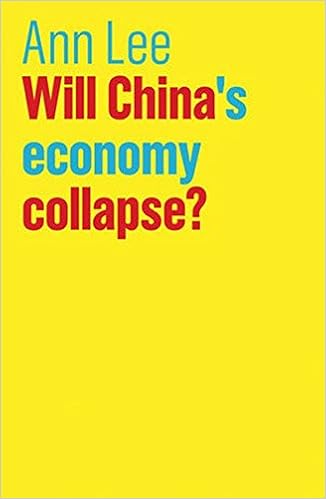
So Ann Lee's book is extremely welcome, particularly if all you know about China is that it has a lot of highly-indebted State-Owned Enterprises (SOEs) and a virulent anti-corruption campaign.
 |
| Amazon link |
At first sight, Professor Lee seems to be a typical member of the global financial elite. According to Wikipedia, she was educated at U.C. Berkeley, Princeton University and Harvard Business School (1995). After working for two investments banks, she became a hedge fund partner and a trader in credit derivatives. In 2007-2008 she was a visiting professor at Peking University.
So some might find it surprising that this book is in fact an unashamed polemic on behalf of the Chinese government.
What do we learn? China is on a trajectory from a purely centrally-planned economy (economically disastrous, as discussed in János Kornai's book, "The Socialist System: The Political Economy Of Communism") towards a mixed economy where the state still controls the commanding heights, the SOEs, and where almost all Chinese companies employing more than 100 people have an internal party cell-based control system.
After an initial export-led lift-off in the 1980s and 90s, the financial crisis of 2008 dramatically curtailed the global market for Chinese products. To avoid massive layoffs and social tensions, the Chinese leadership refocused production on domestic infrastructure, and later global infrastructure projects such as the Belt and Road initiative. This was principally funded by debt, leading to many of the debt-overhang issues identified by economists.
Domestic development was orchestrated by local government in such a vast country, but these institutions were prevented from raising capital directly or running deficits. Instead, they created their own companies, the Local Government Financing Vehicles which were capitalised by land grants or initial cash injections, but which were then able to raise additional funds from banks or the shadow sector.
Debt subsequently ballooned, much of it under the radar of official statistics. Meanwhile property prices were rising fast, showing signs of a bubble.
Professor Lee is sanguine about these risks. Government control of the economy, the existence of capital controls and the increasing global role of the renminbi all combine to afford the Chinese government many economic levers. She does not foresee a hard landing.
In the final part of the book, the author is at pains to identify some of the advantages of the Chinese economic system over that of America. The absence of a litigious culture, the extraordinary talents of the Chinese workforce, and the government's concerns to avoid social division.
China may not be formally democratic in the way of the States, but the party is highly sensitive to public opinion and concerned to prioritise policies which promote social cohesion, such as green development and poverty alleviation.
So that's the argument from the Chinese side of the fence. It's up to the reader, now better informed about the background, to decide which aspects of Professor Lee's arguments they find convincing.

