 |
| Amazon Link |
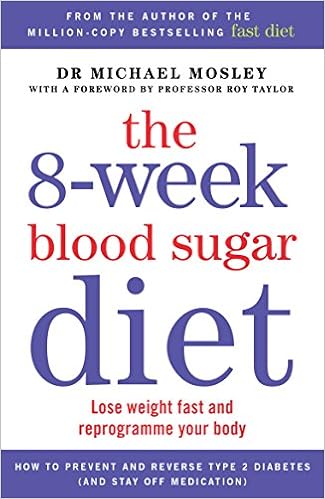
Michael Mosley starts with a story:
"Jon remembers the moment when he first heard he had type 2 diabetes. It was March 17, 2012. The graphic designer, then 48, a father of two teenage sons, was busy with work. His phone rang - it was his doctor's receptionist. "You need to come in straight away. Do you feel OK?" she asked anxiously "Have you got someone with you?" "I think they were worried I was about to go into a coma," Jon says.Our food is awash with sugar and it's not good for us.
"Like many people with this condition, he had no idea that he had a problem. Yet his recent test showed his blood sugar levels were more than three times over the limit. People in Jon's age group are developing type 2 diabetes faster than ever before, and in greater numbers than adults over 65, the group that's traditionally been linked with blood sugar problems.
"Jon was put on medication and sent off to talk to nutritionists and dieticians. What followed was months of conflicting advice. One "expert" told him to eat a whole pineapple every day. Another recommended cereal every morning. No one suggested cutting back his calories, despite the fact that he weighed 21st.
"When he heard about the Blood Sugar Diet he was immediately attracted. It made sense. He liked the fact that it got quick results. He liked the simplicity He waited until the day after his 49th birthday party. He was hung over. Yet despite feeling terrible he was ready to begin a new way of eating which he now says has been "life-changing". He lost 19 lb (8.5 kg) in the first week. I'll repeat that, shall I? 19 1b — literally, the same weight as a car tyre. Much of that would have been water, but still, it was impressive.
"He was staggered — and immediately motivated to keep going. For the first time he remembers being able to wear socks and not feel the elastic digging into his swollen ankles. He dropped a jean size in seven days. "It was such a spur," he says, looking back. "I could see straight away that this was going to work." Jon is a warm, funny guy who likes to party. So he fell off the wagon. Repeatedly "I didn't beat myself up," he says. "I'd just start up again the following day." (It's true that when he sent me his weekly food diaries there was more than the occasional glass of prosecco.)
"Once I got going I stopped thinking about it as a diet. I just decided that this was the way I was going to eat." He started walking more and getting around by bicycle, further burning up the fat stores. In three months, he lost 50 lb (22.5 kg). Friends and family say he looks 20 years younger. He is no longer on his diabetes medication. His blood sugar results are normal. He uses words like "control", "habit" and "automatic". "This feels entirely sustainable," he says. "I've found a way to live and to eat."
"Well, the thing about carbs, particularly the easily digestible ones, such as sugar, but also breakfast cereals, pasta, bread and potatoes, is that they are easily broken down in the gut to release sugar into your system. Your pancreas responds by producing insulin. One of insulin's main jobs is to bring high blood sugar levels down, and it does this by helping energy-hungry cells, such as those in your muscles, take up the sugar. Unfortunately, an unhealthy diet and a low-activity lifestyle can, over many years, lead to what's called "insulin resistance".Dr Michael Mosley's M-Plan diet, based on the Mediterranean diet, aims to cut back on sugar drastically, increase fibre and restore those much-maligned fats to their proper place. I've posted his diet summary here.
"Your body becomes less and less sensitive to insulin. Your blood sugar levels creep up. And as they rise, your pancreas responds by pumping out more and more insulin. But it's like shouting at your kids. After a while they stop listening.
"While your muscles are becoming insulin-resistant, however, insulin is still able to force surplus calories into your fat cells. The result is that, as your insulin levels rise, more and more energy is diverted into fat storage. The higher the insulin, the fatter you get. And yet the more calories you tuck away as fat, the less you have to keep the rest of your body going.
"It's a bit like buying fuel, but instead of putting it in the tank you put it in the boot of the car. The fuel gauge sinks, but your frantic attempts to top up fail because the fuel is going into the wrong place. Similarly, your muscles, deprived of fuel, tell your brain to eat more. So you do. But because your high insulin levels are encouraging fat storage, you just get fatter while staying hungry."
The other two legs of Dr Mosley's three-legged stool are Exercise and 'Sorting Out Your Head". All good advice - cortisol is not your friend.
Some reviewers felt this was a book aimed at those with type 2 diabetes, or pre-diabetes. Not so, it's aimed at anyone whose diet contains too much sugar .. all of us. There are 50 recipes in the latter part of the book, contributed by Dr Sarah Schenker, with some nice coloured plates.
It's an easy and quick read (and the book is cheap, too). Dr Mosley has a history of being reviled by a hidebound medical establishment who insist on medicalising everything, but he retains his usual courtesy in this book.
My only substantive point, apart from that you should definitely read this book, is that his relentless optimism perhaps underestimates the rather unpleasant sugar crash (as in the ITV programme 'Sugar Free Farm') which some readers are bound to experience.
