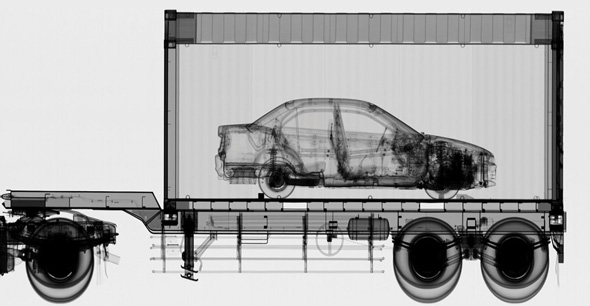
"Every day more than 8,000 containers flow through the Port of Rotterdam. But only a fraction are selected to pass through a giant x-ray machine to check for illicit contents. The machine, made by Rapiscan, an American firm, can capture images as the containers move along a track at 15kph (9.3mph).Scanning images is a tedious task, whether at container ports or at airports. Most likely the security staff will be delighted to see this part of their job automated away. There are unlikely to be directly-attributable redundancies. As The Economist pointed out, they still need customs staff to search the containers.
"But it takes time for a human to inspect each scan for anything suspicious—and in particular for small metallic objects that might be weapons. (Imagine searching an image of a room three metres by 14 metres crammed to the ceiling with goods.) To increase this inspection rate would require a small army of people.
"A group of computer scientists at University College London (UCL), led by Lewis Griffin, may soon speed up the process by employing artificial intelligence. Dr Griffin is being sponsored by Rapiscan to create software that uses machine-learning techniques to scan the x-ray images. Thomas Rogers, a member of the UCL team, estimates that it takes a human operator about ten minutes to examine each X-ray.
"The UCL system can do it in 3.5 seconds."
...
"A paper the group presented at the Imaging for Crime Detection and Prevention conference in Madrid last week showed that in tests, the system spotted nine out of ten hidden metallic objects.
"Only six in every hundred readings flagged a weapon when there was nothing. Dr Griffin says this false positive rate has been reduced to one in every 200 since the paper was written in August. The group’s software has also been trained to detect concealed cars.
The UCL team hopes to test its software shortly on real containers, some with small weapons deliberately hidden inside. Assuming that works, Dr Griffin plans to integrate the artificial-intelligence system into Rapiscan’s scanning systems over the next few months.
"The team is also aiming to train the system to detect “anomalies”—the machine-learning equivalent of a human hunch that something is not quite right about a scan. That could, for instance, be something unusual in the way things are positioned inside the container."
But it's the thin end of the wedge.
---
From the book, "Deep Learning", section 1.2.4
 |
Number of neurons in various AI systems vs biology |
System 20 is GoogLeNet, brought to you by Google for image analysis.
Your take home message is that these wonderful AI learning systems which so impress us have, at best, the neural power of a frog. A human-level neural capacity is predicted for 2056 (which seems conservative).