Showing posts with label Catholic Social Teaching. Show all posts

Wednesday, July 08, 2026

JD Vance: Towards a Catholic Political Economy? (via GPT5.5)


JD Vance: Towards a Catholic Political Economy?

JD Vance’s reception into Catholicism has supplied a moral language for an economic politics he was already developing. In his new book, Communion, and his public speeches, he rejects the assumption that an economy can be judged chiefly by GDP, consumer prices and aggregate efficiency. Work forms character, production sustains communities, and families depend upon secure employment, housing and social continuity. This is closer to Catholic Social Teaching than Reaganite market individualism. It also recovers the valid post-Marxist insight that relations of production shape culture, family life and political allegiance.

Vance’s practical answer is a national developmental capitalism: tariffs, reshoring, restrictions upon cheap imported labour, inexpensive energy, deregulation and technological investment. His strongest argument is that deindustrialisation never merely transferred routine production to cheaper locations. It also transferred skills, supplier networks and production knowledge. The countries that manufacture products become increasingly capable of designing them - China being exhibit A here. 

From a Schumpeterian perspective, an economy that stops making things may eventually lose the capacity to invent the next generation of things. Vance’s proposed combination of tariff protection, robotics and higher labour productivity is therefore more serious than simple nostalgia for lost blue-collar factory jobs.

The conventional objection is that protection creates vested interests and preserves inefficient firms. True, but incomplete. Free trade also creates organised beneficiaries: importers, financial institutions, multinational supply chains and professional elites. Olson’s lesson is not that government intervention uniquely produces capture, but that every durable economic settlement generates coalitions able to defend it. Onshoring may consequently be justified despite some loss of immediate efficiency where national security, technological sovereignty or supply resilience are involved.

Vance’s real weakness lies in institutional design. Protection should create capabilities, not pensions for incumbents. Tariffs, subsidies and tax privileges should be conditional upon investment, productivity, training, domestic supply chains and technological advance, with expiry dates and clawbacks. Procurement should remain open to new entrants, while competition policy restrains protected firms from converting strategic support into monopoly rents. Trusted-allied supply chains will often provide greater resilience than national autarky - no one-size-fits-all architecture works well here. Creative destruction must continue inside the protected space.

The same qualification applies to labour. Catholic teaching rightly insists that workers are to be considered persons rather than disposable inputs, but unions themselves easily become Olsonian organisations defending obsolete jobs, restrictive practices and privileged insiders - indeed that is their default position.

The objective should be to protect workers through economic change, not to protect every existing job from change. Portable benefits, wage insurance, retraining targeted to real vacancies, relocation assistance, employee profit-sharing and broad social insurance serve workers’ collective long-term interests better than simply strengthening established unions. Catholic Social Teaching supports worker association, but places it within the wider principles of human dignity, solidarity, subsidiarity and the common good.

Vance’s achievement is to have broken with the fiction that markets are socially neutral: they are not. His weakness is that he still relies too heavily upon superficial solutions: tariffs, patriotic employers and moral exhortation.

A mature Vance programme would discipline both capital and organised labour, support innovation without abandoning communities, and require every protected interest to continue earning its privileges. That would join Catholic moral purpose to Schumpeterian dynamism and Olsonian realism: not the preservation of an inherited industrial order, but the construction of institutions through which workers and communities can prosper amid continual economic transformation.

Wednesday, August 24, 2016

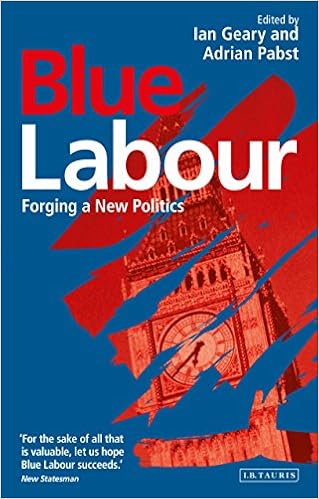
Blue Labour - so disappointing

I was really prepared to like Blue Labour and to that end bought this book.

Amazon link

I read about half the essays before finally choking on the conceptual equivalent of mushy bran.

Here's the story from Wikipedia.
"Labour peer and London Metropolitan University academic Maurice Glasman launched Blue Labour in April 2009 at a meeting in Conway Hall, Bloomsbury. He called for "a new politics of reciprocity, mutuality and solidarity", an alternative to the post 1945 centralising approach of the Labour Party.

"The movement grew through a series of seminars held in University College, Oxford and at London Metropolitan University in the aftermath of Labour's defeat in the 2010 general election.

"Labour figures sometimes associated with the trend have criticised the New Labour administration of Tony Blair for having an uncritical view of the market economy, and that of Gordon Brown for being uncritical of both the market and the state.

"Jon Cruddas, the Labour MP for Dagenham and Rainham and the party's policy review co-ordinator, argued that New Labour's focus on 'the progressive new' resulted in the party embracing "a dystopian, destructive neoliberalism, cut loose from the traditions and history of Labour".

"Chuka Umunna, the Labour Shadow Business Secretary believes Blue Labour "provides the seeds of national renewal".
Chuka Umunna, one of the high priests of metro-liberalism, a Blue Labour guru?

Give me a break.
"Blue Labour suggests that abstract concepts of equality and internationalism have held back the Labour Party from linking with the real concerns of many voters, the concept of equality leading to an 'obsession with the postcode lottery' and internationalism ignoring fears of low paid workers about immigration.

"Blue Labour, alternatively, emphasises the importance of democratic engagement and insists that the Labour Party should seek to reinvigorate its relationships with different communities across the nation, with an approach based on what historian Dominic Sandbrook describes as "family, faith, and flag".
The essays, highly overlapping and uniformly light on conceptual depth and rigour, feature:
  • An ethical/cultural critique of liberal individualism
  • An economic critique of rampant globalism
  • A religious critique of secular atomisation.
So what is to be done?

Way too many essays base themselves on Catholic Social Teaching (various Popes get extensive name checks), a naive idealisation of the increasingly dysfunctional German social and economic model (workers on boards, apprenticeships etc) and the communitarian history of the British labour and cooperative movements over the last couple of hundred years, going back to the Romantic tradition of John Clare (yes, he gets a name check too).

There is no analysis of just why metro-liberal politics, economics and culture have proved so hegemonic over the last few decades everywhere in the western world, and no plausible political programme for going forwards - nothing beyond tinkering at the edges (community organising, anyone?).

No, Blue Labour is a superficial nostalgia-fest built on sand.

Sad.

---

I also bought this which I have yet to read:

Amazon link

I have no hopes.

---

Update (28th August 2016).

I've completed Rowenna Davis's book and it's an easier read than the essay collection above, as well as being way more insightful. It covers the 18 months stretching from the end of Gordon Brown's premiership to the Miliband brothers election and Ed's first year. During this time Blue Labour emerged and then became dominated by Maurice Glasman once he had been elevated (by Ed) to the Lords.

Glasman emerges as an argumentative, self-willed and naive radical activist who fell out with many of his co-thinkers. Interestingly, these were mostly Oxford academics. The other major support groups for Blue Labour were community activists (Citizens UK, led by a patrician bunch of Oxford graduates) and faith groups (Catholics and Muslims predominated).

When the book ends, in 2011, Blue Labour is imploding due to Glasman's egotistical gaffes. Plainly, it recovered later, but in the age of Corbyn its profile today is invisible.

I'm left with the lasting impression that, despite the academic credentials of its founders, the Blue Labour movement is distinctly lacking both in intellectual depth (in general) and in any analysis of 21st century capitalist dynamics (specifically).

It is possible that the Labour Party, as we know it, has no viable go-forward mission at all.