Saturday, March 30, 2019

Dominic Cumming's new political party?


Dominic Cummings

In his blog:  (my emphasis):
"Start rebuilding our network now. The crucial data to collect: name, email, postcode, mobile (full address if possible). If we need to set up a new entity — a campaign, a party — you will be able to plug this straight into new data infrastructure and we will try to grow super-fast. And it looks like we will need to…

Remember: we won last time even though the Establishment had every force with power and money on their side. They screwed it up because they do not have good models of effective action: they literally do not know what they are doing, as they have demonstrated to the world in the farcical negotiations. They are screwing up their attempt to cancel the referendum. Beating them again and by more will be easier than 2016.

Also, don’t worry about the so-called ‘permanent’ commitments this historically abysmal Cabinet are trying to make on our behalf. They are not ‘permanent’ and a serious government — one not cowed by officials and their bullshit ‘legal advice’ with which they have herded ministers like sheep — will dispense with these commitments and any domestic law enforcing them.

And next time we will not close down — we will try to ensure that votes are respected and the malign grip of the parties and civil service is broken, as Vote Leave said should happen in 2016.
I'm interested, Dominic, and not without some sympathy. But explain yourself clearly: what is your party going to be for?

Thursday, March 21, 2019

Beyond capitalism: is this the best we can hope for?

It's to easy to reify capitalism. To see it as the capitalist class (hiss!) bearing down upon the downtrodden proletariat. 

Expropriate them!

---

1. The inner-truth of capitalism

Let's do the analysis right.

Consider the vast mass of people who cannot live by their own efforts (they have no land, no resources, they are not self-sufficient). The proletariat.

Add a minority who own the land, the factories, the machines, the tools, the raw materials and all the other means of economic production. Ownership guaranteed by law and state. The capitalists.

If the owners hire workers (their capacity to work, actually) at a rate which can reproduce them for work next day, week, year .. while the amount produced by said workers exceeds their wages in value, well the surplus will be owned by the capitalists. They will get consistently richer. We have a technical name for this: it's called profit and it's a good thing. It means social needs are being addressed efficiently.

Note: if you work for the state rather than a private-sector employer, your wages are paid out of taxes: value contributed ultimately by the capitalist sector.

2. What do the capitalists do with their ever-increasing riches? 

An insignificant relative proportion goes into luxury apartments and super-yachts (although this conspicuous consumption is a powerful human motivator and source of envy and resentment). The statistics show that most capitalist profits are re-invested to secure another round of expanded reproduction. Or in these stagnating times, financing debt.

M - C - M' in Marx's formula. Money makes money through the intermediary of surplus value production.

Gratuitous consumption is always a missed opportunity under capitalism. An opportunity cost.

In the nutshell, it is the way production is organised which creates the classes .. they are both a precondition and a consequence of the relations of production.

3. Capitalism really pushes the social-surplus product

No moralism. We're none of us going back to living off the land. Noble hunter-gatherers, trapped in the deepest well of unproductive subsistence.

Nor are we going back to the agrarian life, another low-productivity hell-hole where almost everyone is tied to mediocre, hard, tedious life on the land.

We all agree that human affairs are improved when we have a better constructed-environment, one which suits our diverse needs. The way we do that is by a global division of labour where projects of the most ambitious scope can be realised. I like modern medicine.

That's going to take a lot of social-surplus product going forwards. It's going to continue to require people to personally consume only a small fraction of the value they themselves produce.

Any one individual is going to look at projects on all scales up to the fully global and subjectively feel like a small cog in a vast machine.

I wonder though whether they'll really care. Nobody asks me about NASA but I can still get excited.

Who decides what projects should be done, if not individual capitalists who have succeeded in attracting investment capital? I refer you to the pessimistic literature on traditional post-capitalist organisational forms well-documented here.

4. A post-capitalist economic organisation we might expect

Suppose we get the miracle of total automation. Cognitive robots replace workers. But in the end, without wage-labour, profits can't be obtained.

Under capitalism, the capitalist who automates gets a short-term advantage but then overall profits fall. Competition means that in the steady-state the capitalist cannot charge more than will cover his costs. Without wage-labour creating additional value, sale-prices are simply bid down to the costs of robots, overheads and materials. As a consequence, profits tend to zero.

The capitalists don't invest. It's like an economic crisis which never abates.

5. The Roman Empire redux

An economy of petty-commodity production is what still works. Like the Roman Empire of antiquity. The slaves have been switched out for robots. Units of production produce lots of goods  which are sold at their value, like in a village marketplace.

The Roman Empire was economically complex and vast in space and time. It was not very productive, not very dynamic - which may have been due to its agrarian character. And slaves are not the ideal robot - far from it. Not biddable at all.

Some people think the answer is for everyone to own personal robots. In antiquity most of the elite fraction of society had at least a few household slaves. But that isn't commensurate with distributing widely the benefits of a sophisticated global economy.

If I had to guess, I would say that the automation-heavy future is essentially robot-powered petty-commodity production combined with a very generous guaranteed income for everyone. Add in genetic enhancement to exploit the possibilities of an improved humanity and we'll not be in a bad place.

At least until the AIs decide we're a waste of their space!

---

Note: the Marxist economist Michael Roberts has written extensively about the consequences of total automation under capitalism. Here's a good place to start.

Saturday, March 16, 2019

Post-capitalist and post-human?

Amazon link

I finally completed Poulantzas's turgid, repetitive, over-abstract and slightly-dated book. Far from a page-turner. Yet really important for the final few chapters.

Poulantzas turns his educated, sophisticated Marxist eye on the problem of transition and the nature of the socialist state. Let me crudely summarise.

Poulantzas understands completely the Leninist model of 'soviet democracy': that is, a hierarchy of workers' councils running everything as the proletarian state. He understands that this doesn't work. It requires a mobilisation of the masses which cannot last indefinitely. It isn't an efficient decision-making mechanism due to the need for expertise. It cannot replicate the enormously complex and specialised functions and services undertaken by the bourgeois state apparatus, which would only increase after the supercession of capitalism.

His solution is a transformed and transforming bourgeois-like state apparatus (i.e. a state bureaucracy) kept on the straight and narrow by parallel popular structures. The interplay between these two loci of power is under-defined, and, as he himself point out, inevitably leads to existential conflict. It's unstable.

Really, Poulantzas sees no way out.

I would add that with actually-existing humanity, both bureaucratic structures and a hierarchy of councils invariably ossify into self-serving elites which stagnate as they succumb to the principal-agent problem.

Altruism meets its limit in Dunbar's number.

How does capitalism avoid these problems? Poulantzas correctly observes that the state is not a dominant participant in the relations of production, which are those of privately ownership of the means and objects of production. A hegemonic bourgeoisie tolerates nationalisation only in the event of market failure.

We can additionally note that the only thing which keeps social agencies competent and innovatory is competition. The fear of losing everything saves a structure from complacent featherbedding and elite-capture. Remove competition and things slow to an ossified crawl and the tyranny of the elites is assured.

And so the destruction of the capitalist mode of production and its replacement by central planning leads to Stalinism. This is Poulantzas's compelling (and unwanted) conclusion.

---

Amazon link

I'm debating getting this. I read the intro, where Žižek seems to share Poulantzas's general conclusions, but seems to have reverted to a strategy which Poulantzas correctly rejects: the encirclement of global imperialism by municipal, localised, counter-initiatives.

This has been a popular, albeit minority view in the Left: I wrote about Paul Mason's similar views. A counter to reformist social-democracy, a paradigm in worldwide collapse.

Utterly unconvincing of course.

Žižek gets brownie points for taking notice of the scientific advances in psychometrics, behavioural genetics and the like (cf. Plomin). Most writers in the Marxist tradition have taken the intellectually-suicidal route of turning their blind eyes to this and retaining a touching faith in blank-slatism verging on vitalism.

Žižek has little idea, however, as to how to integrate these new understandings of human nature into the traditional Marxist world-view. But in the longer term (which will still be co-extensive with the reign of capital) humanity will be as labile as any other innovating technological factor.

A society of clones could make communism - as anticipated by the founders - work, at least for a while. It is the only possible genetic underpinning of the perfect altruism required. Such a solution is, of course, genetically unstable. Utterly at the mercy of defection-mutations (if they are not ruthlessly suppressed). Oh, and evolution doesn't much like clone-species - too brittle with zero population variation.

It's imaginable that capitalist dynamism could be combined with a greater propensity to income-equality and tolerance of transfer payments. But I don't think we could take it too far, a kind of über-Denmark. The psychological attributes which make capitalism - red in tooth and claw - work seem incompatible with excessive hand-wringing liberalism. Ask Justin Trudeau.

Sunday, March 10, 2019

GPT-2: what does it mean?


This got a lot of attention.
"System Prompt (human-written)

In a shocking finding, scientist discovered a herd of unicorns living in a remote, previously unexplored valley, in the Andes Mountains. Even more surprising to the researchers was the fact that the unicorns spoke perfect English.

Model Completion (machine-written, 10 tries)

The scientist named the population, after their distinctive horn, Ovid’s Unicorn. These four-horned, silver-white unicorns were previously unknown to science.

Now, after almost two centuries, the mystery of what sparked this odd phenomenon is finally solved.

Dr. Jorge Pérez, an evolutionary biologist from the University of La Paz, and several companions, were exploring the Andes Mountains when they found a small valley, with no other animals or humans. Pérez noticed that the valley had what appeared to be a natural fountain, surrounded by two peaks of rock and silver snow.

Pérez and the others then ventured further into the valley. “By the time we reached the top of one peak, the water looked blue, with some crystals on top,” said Pérez.

Pérez and his friends were astonished to see the unicorn herd. These creatures could be seen from the air without having to move too much to see them – they were so close they could touch their horns.

While examining these bizarre creatures the scientists discovered that the creatures also spoke some fairly regular English. Pérez stated, “We can see, for example, that they have a common ‘language,’ something like a dialect or dialectic.”

Dr. Pérez believes that the unicorns may have originated in Argentina, where the animals were believed to be descendants of a lost race of people who lived there before the arrival of humans in those parts of South America.

While their origins are still unclear, some believe that perhaps the creatures were created when a human and a unicorn met each other in a time before human civilization. According to Pérez, “In South America, such incidents seem to be quite common.”

However, Pérez also pointed out that it is likely that the only way of knowing for sure if unicorns are indeed the descendants of a lost alien race is through DNA. “But they seem to be able to communicate in English quite well, which I believe is a sign of evolution, or at least a change in social organization,” said the scientist."
---

Here's what Open AI, the developers of GPT-2, had to say.
"Our model, called GPT-2 (a successor to GPT), was trained simply to predict the next word in 40GB of Internet text. Due to our concerns about malicious applications of the technology, we are not releasing the trained model. As an experiment in responsible disclosure, we are instead releasing a much smaller model for researchers to experiment with, as well as a technical paper.

GPT-2 is a large transformer-based language model with 1.5 billion parameters, trained on a dataset of 8 million web pages. GPT-2 is trained with a simple objective: predict the next word, given all of the previous words within some text. The diversity of the dataset causes this simple goal to contain naturally occurring demonstrations of many tasks across diverse domains. GPT-2 is a direct scale-up of GPT, with more than 10X the parameters and trained on more than 10X the amount of data.

GPT-2 displays a broad set of capabilities, including the ability to generate conditional synthetic text samples of unprecedented quality, where we prime the model with an input and have it generate a lengthy continuation. In addition, GPT-2 outperforms other language models trained on specific domains (like Wikipedia, news, or books) without needing to use these domain-specific training datasets. On language tasks like question answering, reading comprehension, summarization, and translation, GPT-2 begins to learn these tasks from the raw text, using no task-specific training data. While scores on these downstream tasks are far from state-of-the-art, they suggest that the tasks can benefit from unsupervised techniques, given sufficient (unlabeled) data and compute.

Samples

GPT-2 generates synthetic text samples in response to the model being primed with an arbitrary input. The model is chameleon-like — it adapts to the style and content of the conditioning text. This allows the user to generate realistic and coherent continuations about a topic of their choosing, as seen by the following select samples.

[Then there follows the 'Unicorn' text you already saw above]."
---

Scott Alexander got pretty excited about GPT-2's capabilities and wrote a series of posts arguing it was a significant step towards AGI (artificial general intelligence). This was based on his thesis that all of intelligence is predictive modelling and therefore in some sense AGI is a linear extrapolation of what GPT-2 is doing.

---

I'm not that excited about the fake news aspects. Deep-learning is tearing the ground up in the field of stochastic prediction. We're just at the foothills - to mix the metaphors. It's all quite unstoppable.

As long as we live in a human-dominated society, what you read from GPT-2 and its brethren will be what some human wants you to read. So the semantic content of the message will be parasitic on whatever the human wanted to communicate - lies or truth or bias or opinion or whatever.

So the AI is a prosthesis. Get over it.

---

I'm much more interested in the architectural questions.

The most perceptive assessments of deep-learning architectures address the critique that engineered systems adopt a tabula rasa methodology. The systems have zero prior knowledge, and merely induce parsimoniously from the offered data sets.

To which there are two good responses.

Firstly, there are many different artificial neural net topologies. For example, convolutional neural nets have a structure similar to that of the biological visual cortex and are used (amongst other things) for image processing, for example, scene and facial recognition. The pattern of local connectivity in the early processing stages of these nets implements the convolution operations which are known to be relevant to feature extraction.

Evolution didn't know that in advance. The earliest biological neural nets for vision which had been selected for ended up with this near-neighbour property genetically-coded, before they had registered even a single image. The same is true for artificial systems.

Brain anatomy does not present as a uniform pudding bowl of grey porridge. The brain has discrete modules with complicated names. Why? I guess because they do different kinds of processing and are therefore topologically optimised for different kinds of operation. We don't know yet.

In AI we have the luxury of flexibility. With a new kind of problem-domain we can experiment with all kinds of different topology, both before training and also by observing weight assignment after training. Deep-learning is going to evolve towards a brain-like situation where the data-processing invariants for all kinds of distinct tasks (such as effector-control, taste-analysis, 'emotion'-processing and consciousness-like functions) are engineered each with their optimised neural net architecture - once we discover what that is.

---

To produce text which works as an intervention in human affairs you have to be a social actor and have interests.

GPT-2 is not in any important sense an architectural precursor of such a scarily-political AI.

The misunderstandings of eusociality

"An early 21st century debate focused on whether humans are prosocial or eusocial. Edward O. Wilson called humans eusocial apes, arguing for similarities to ants, and observing that early hominins cooperated to rear their children while other members of the same group hunted and foraged. Wilson argued that through cooperation and teamwork, ants and humans form superorganisms. Wilson's claims were vigorously rejected because they were based on group selection and reproductive division of labour in humans."  -- [Wikipedia].
---

My review

 ---


My review
 ---

People puzzle at how human societies of thousands to millions to billions can form, how they can be stable. Some people fantasise about some mysterious genetic glue which fosters ultra-scalable human bonding, at least among co-ethnics.


My review
---

I am a believer in Robin Dunbar's number:
"By using the average human brain size and extrapolating from the results of primates, he proposed that humans can comfortably maintain only 150 stable relationships."
Pre-capitalist social formations (tribal federations, archaic empires, slave empires, feudal states) were invariably hierarchies based on the elite violence of family-clans. Horizontal kin-preference plus reciprocal-altruism was the glue which held society together, whether at court or in the village-hovels.

Game of Thrones.

When you do political violence to someone, you are not in a social relationship of asabiyyah with them. This is not eusociality.

---

Capitalism removed the means of livelihood from the mass of the population (the 'proletariat') and thereby forced them into the transactional relationship of wage-labour. This is a scalable fact of capitalist economics but does not depend upon some upending of the individual's interpersonal capabilities.

If each human is a node in a graph, the number of personal links per node remains less than or equal to Dunbar's number.

The web of links, however, spans the world.

---

Marxists like to talk about this as commodity fetishism, which socialism will supersede.

The 'workers councils' model is hierarchical and no-one believes in its long-term stability any more. Mass mobilisation is not sustainable, ignoring all the other difficulties such as informed choice and that irritating human lack of global altruism. Yet global coordination is necessary to mobilise the social forces of production, the future socialist global economy.

The need for a global coordination network combines with the human capacity for only a tiny number of reciprocal links. The solution is always hierarchy (at least until we subcontract everything to the AIs). And so the problems start. People are instinctively aware of them, hence the visceral urge for egalitarianism.

As the link-depth grows, relationships become remote, principal-agent problems emerge, the forces at the top of the hierarchy arrange things in their own immediate interests, the bubble re-emerges.

Capitalism addresses this inherent problem by a radical economic decentralisation: private ownership of the means of production at all scales. Coordination occurs via dynamic market-exchange.

The Marxist theory of crises

People occasionally comment on the subsequent problems: the proletariat disproportionality suffers during the inevitable crises.

---

As János Kornai observed however, in centrally planned economies there is no countervailing, decentralising force. The links which constitute the economy are held in place, reproduced - and always for the benefit of the elite - by total surveillance backed by force.

My review


Welcome to the human condition. The maze without an apparent exit.

Friday, March 08, 2019

Lenin 2017: Slavoj Zizek

Amazon link

This was my first exposure to Slavoj Žižek's writing. He contributes a substantial opening essay and a small afterword. Half of the book is devoted to Lenin's writings in the last years of his life (1921-23). This was the period of the NEP, the New Economic Policy, and Lenin was intent on defending this 'reversion' to capitalist economics while simultaneously denouncing the gathering, inertial growth of 'the bureaucracy', in fact the recomposition of a fundamentally unreformed Tsarist state apparatus.

In hindsight, Lenin's myopia is truly sad. He sees the problem in organisational terms, proposing a revamped Control Commission of good communists to root out corruption. He also calls for intensive education, both in general and specifically in management principles, to be made a priority. Everywhere he sees a 'lack of culture', which is rendering the efforts of the communists to chart a proletarian way forward null and void.

Fine speeches are being made by the Bolshevik intelligentsia, but the state machine - its numberless functionaries - sits in torpid paralysis, looking after its own material interests.

Lenin writes in clear and increasingly urgent terms as his illness gets worse. He sees the disease creeping into the ranks of the Party itself.

Žižek's writing, by contrast, is weaselly. First the credit: Žižek is smart, well-read and has thought about things. He has, though, no good answers as to why the revolution finally failed (1991) or what the ambitious and dedicated Marxist should be aspiring to today.

He hides this ignorance in the highly abstracted language of Hegelian-tinged continental Marxism in which the ploy is to recompose the problem in tiers of layered abstractions, without ever instantiating the resulting totality to a decisive and compelling problematic of transition.

See, I can do it too.

I agree that in this theoretical hole, Žižek is not alone. Indeed no-one has been able to find their way out. Žižek is surely best as a cultural critic and debunker and that alone is worth the price of his books. I will read more of him.

Monday, March 04, 2019

Game Changer: AlphaZero (Book Review)

Amazon link

I bought this book because I was interested in how the architecture of a deep-learning neural-net chess program differs from the tree-search paradigm of existing programs. From my point of view there are some rewarding sections: the introduction by Garry Kasparov, the autobiographical chapter by DeepMind founder Demis Hassabis, the overview essays by the authors (and chess experts) Matthew Sadler and Natasha Regan, and in particular chapter 4, a detailed analysis of 'How AlphaZero thinks'.

Most of the book, however, is devoted to detailed analysis of games between AlphaZero and the current computer world champion program Stockfish. It is a contest of attacking flair from DeepMind against inexorable nitpicking from Stockfish. Flair beats pedantry pretty much every time in this battle of the AIs. That is not, however, the human experience!

Although there are easy-to-read insights for the reader primarily interested in AI, these could be as easily obtained from the Wikipedia article on AlphaZero. This book will be of greatest interest to serious chess players who will want to do as recommended and play the many games analysed in detail on their own boards.

It is promised that they will learn a great deal.

Sunday, February 24, 2019

TIG of the dump

This is a post about The Independent Group.

My reading about the (now ancient - 1998) dispute between Ellen Meiksins Wood and Nicos Poulantzas as to the status of white-collar ‘new professionals’ has been educational.

Poulantzas argued that these gentrified yuppies: hipsters, lawyers, journalists, media people, architects, lecturers - bubble people par excellence - were not part of the working class at all, they were the new petty-bourgeoisie. They had a distinctive class interest (they were unproductive workers in Marxist terms) and exhibited a contingent relationship with the proletarian class struggle.

Woods observed acidly that in every case we're talking about people who have been dispossessed of means of production, people who need to sell their labour power to survive. Look, they're workers!

---

So how come they look so different to the traditional blue-collar manual working class? Our middle-class workers are educated, articulate, individualistic and, where active, fervent on identity issues. Class thoughts never enter their heads. They are post-class.

As always we have to look at the specific evolution of capitalism, particularly over the last decade or so, to understand the real situation here.

The traditional surplus-value-producing working class is, to our surprise, still with us: in car plants, mines, docks, transport, construction and a thousand subcontractors. They have no voice in the media and are rarely seen there, but they haven’t gone away. Instead, a decade of steady but anaemic growth has rendered them apathetically, resentfully quiescent.

The great four-decade expansion of automation, financialisation and globalisation has dramatically expanded the number of jobs in the circulation of capital (sales, marketing, advertising, PR, media), in financial services and for the state. Most of these workers are not directly involved in the production of surplus value per se; they skim the value produced by other workers as Woods reminds us. Yet workers they are, nonetheless. Their jobs are less obviously ‘working for the Man’ - in fact they can offer significant opportunities for autonomy and creativity -  and they are sometimes quite well paid (although by no means always - a source of anger).

It is easy to see why Poulantzas saw this working class fraction as petty-bourgeois. They tend to see themselves as floating free of the production processes of the economy, part of the general cultural superstructure. They internalise the dominant ideology of bourgeois liberalism (not an pejorative term at all here; descriptive) and push it to its pure extremes.

The result is the cult of social-justice, its contours carefully, albeit subconsciously, edited for consistency with the reproduction of capitalist social relations. Everyone talks about material inequality (those huge ratios) yet no-one seriously agitates to do anything about it - it's an abstraction; transgender equality, however, is a cause to die for

No-one talks about class. Even the existence of classes in the context of economic dominance is denied; class is conceded to be at most a cultural signifier, subordinate to intersectional identity.

This sociological fractioning is prevalent across the advanced capitalist countries. All that has changed in recent years is that continuing anaemic growth - which does not offer advancement prospects to either the blue- or white-collar fractions of the working class - has led to mounting (though inchoate) discontent and new mobilisations on the streets.

The traditional blue-collar working class is resentful and votes for Brexit or Trump - the conservative, anti-elite populists. The white-collar working class votes for Sanders or Corbyn - the progressive (in cultural terms) populists. The real political expression of the über-elites, the Osborne-Obama-Macron-Merkel axis, has hit the buffers and is failing to attract support outside those closest to the coat-tails of the international elites, Davos Man and assorted wannabes.

It's a problem.

In UK terms, we see the Tory’s Theresa May defiantly holding a course designed to appeal to the domestic, anti-globalist fraction of the UK national bourgeoisie plus a fraction of the English blue-collar working class abandoned by Labour; we see Labour’s Corbyn and Momentum hoovering up the embittered white-collar workers (together with some petty-bourgeois forces, for sure, students and the artisan self-employed) who want to complete the bourgeois revolution to the max and advance their own prospects.

And then there is The Independent Group, that remnant from the Blairite-Cameron glory days, wondering if there is a social base for its nostalgic brand of neoliberal 'revival'.

I suspect not.

---

Rod Liddle in The Sunday Times this morning was talking-up a party representing his own preferences: Blue Labour (and Red Tory). That would be the current Social-Democratic Party.

In common with most people, I had thought the SDP had finally died back in 1990.

I can see why Rod kind of likes this ghost of times past, but the SDP (now) is destined to be even more ineffectual than TIG. It presents a brand of one-nation Labourism/Toryism which articulated the narrative of 1950s ascendant national capitalism, but which is completely inapplicable to the current period of neoliberal decay.

It's a dated answer to a question which has not yet been put.

Saturday, February 23, 2019

Theorising the contemporary left, its tasks and prospects

Amazon link


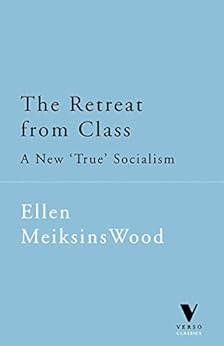
I've just read Ellen Meiksins Wood's rather turgid book (above) where she defends Marxism against the Eurocommunists (remember them?) and those post-Marxist thinkers who were in the process of abandoning class analysis to morph into the identity theorists of today.

She was writing in 1998, when the whole SJW thing was beginning to lift off. I was oblivious at the time, working hard as a network architect with no time for politics.

She's good and she's not. She skewers (although at inordinate length) a number of theorists (most of whom I'd not really heard of) who now, twenty years later, are aged and in retirement. But her analysis struggles to get beyond a restatement of timeless Marxist orthodoxies.

Wood is interesting on the state in a post-capitalist society (one where capitalist relations of production are not dominant). She understands the coordination problems and sees the naivety (her words) in thinking that the state can - as a formation - just 'wither away', or be replaced by endless popular mobilisation through 'councils'.

She is unconvincing as to whether capitalism is perennially problematic for the dispossessed proletariat - some might say that it's on an improving track on a time-averaged scale of decades. She has nothing useful to say about the transition, nor about the well-known difficulties of central-planning and the associated principal-agent problems.

So I thought that overall, her argumentation was sterile and failed to address the issues the heretics were mostly getting wrong. And I wondered where are the young theoreticians, coming into their prime today, who can truly advance a Marxist understanding of the present conjuncture?

Slavoj Žižek?

Really?

Tuesday, February 19, 2019

A quick review of my plans (no more French classes!)

My little foray into improving my French did not last long. I sent the following email this morning [translation at the bottom of the page].

---

Un rapide aperçu de mes projets

"Chère Annie,

J'attends notre cinquième cours cet après-midi, mais je pense que ce sera le dernier pendant un moment.

Cela n'a rien à voir avec ton excellent enseignement! Je suis impressionné par ton travail acharné et ta préparation - tu es toujours incroyablement serviable et sympathique.

Voici ce que je pense. J'ai commencé ces leçons avec toi pour deux raisons. Premièrement, je voulais vérifier mes propres compétences en conversation (pas aussi bonnes que je le pensais!). Deuxièmement, je voulais évaluer combien d'efforts et de temps seraient nécessaires pour atteindre un niveau de base de compétence parlée.

Il semble clair que je devrais passer une heure par jour, presque tous les jours pendant au moins un an, pour atteindre le niveau minimum qui me conviendrait le mieux. Malheureusement, je ne peux pas maintenir ce niveau de travail. Cela prendrait la place d'autres projets que je veux faire.

C'est donc à contrecoeur que j'ai décidé de suspendre mon étude du français pour le moment.

Meilleurs vœux,

Nigel.
"

---

I'm not really surprised. I have a history of throwing myself into things and then deciding that long term, they're just not sustainable .. and then just dropping them. Is that bad? Don't think so. Otherwise I'd be stuck my whole life doing just one thing.

---

I asked Annie this afternoon where, in terms of her school-students, she thought I was. She reckoned at AS level (one year into the sixth form). That is roughly the amount of school study I did back in the day.

I shared with her this calculation:
  • ten new words a day with almost perfect recall is an additional 3,000 words over a year. That isn't going to make colloquial French speakers effortlessly understandable;

  • half an hour of me speaking French to Annie once a week equates to 25 hours a year. Hardly the route to fluency in speaking.
And even this low rate of engagement requires perhaps an hour or so of study a day: working on exercises, checking grammar, looking up words and phrases, reading French text, translating dialogues from English, listening to French broadcasts. Other topics are being neglected. Truly there is no royal road to foreign language competence.

I must say Annie took it well.

----   Here's the translation ----

 A quick review of my plans

Dear Annie,

I look forwards to our fifth lesson this afternoon, but I think that that will be the last one for a while.

This has nothing to do with your excellent teaching! I am impressed by your hard work and preparation - you are always incredibly helpful and sympathique.

Here is what I think. I started these lessons with you for two reasons. Firstly, I wanted to check my own conversational skills (not as good as I thought!). Secondly I wanted to assess how much effort and time would be needed to get to a basic level of spoken competence.

It seems clear that I would need to spend an hour a day, almost every day for at least a year to reach the minimum level I would be pleased with. Unfortunately I can't sustain that level of work. It's taking the place of other projects I want to do.

So reluctantly I have decided to suspend my study of French for the time being.

Best wishes,

Nigel.